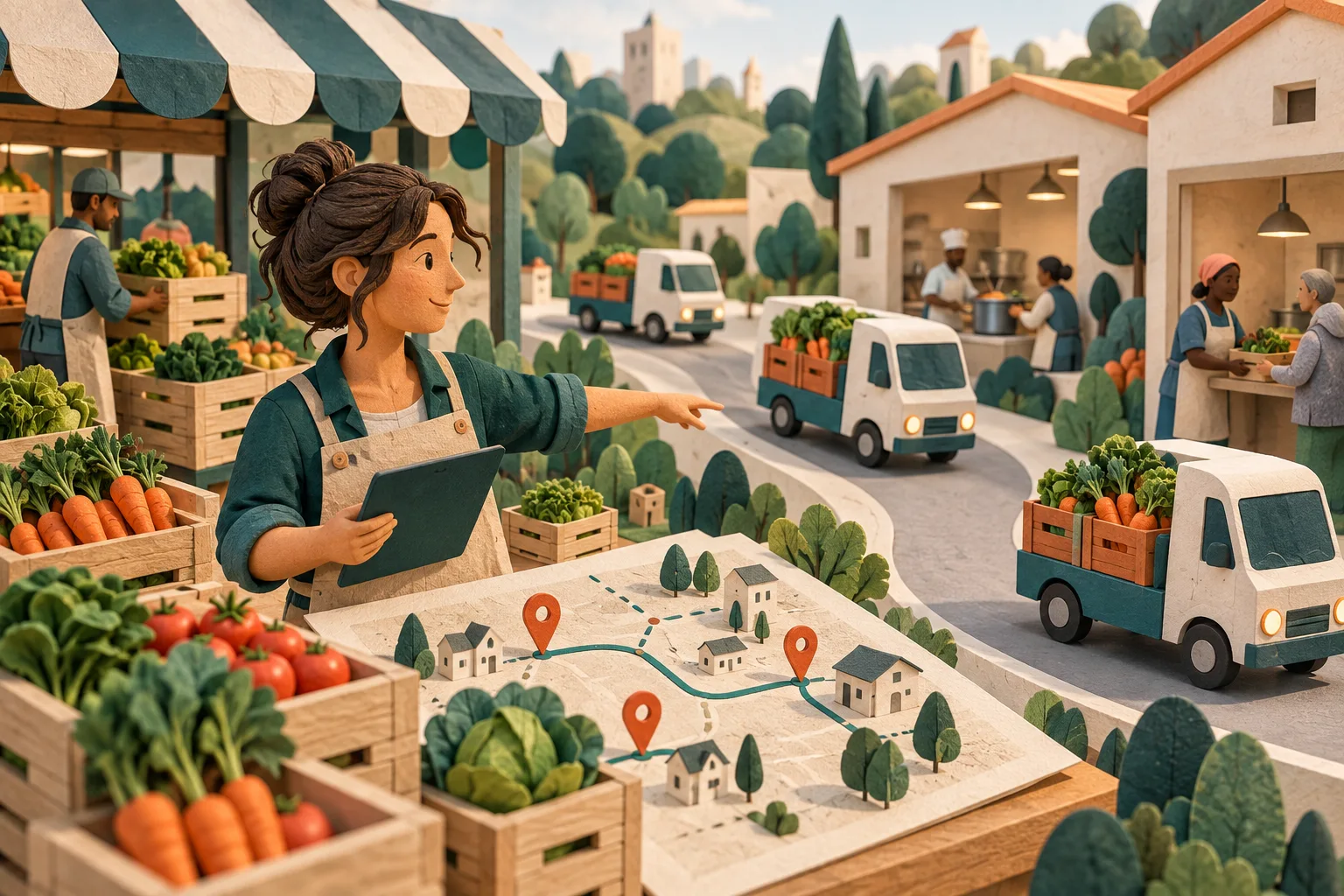
Choose one track. Master’s proposals target Spring 2027. Final scope and programme approval are agreed with the supervisor; bachelor scopes are suggested adaptations.
TRACK 01 · IMPLEMENTATION INCLUDED
Technical track
Develop a working solution and test whether it addresses the problem.
Possible research question
How can decision support coordinate uncertain supply and demand while balancing waste, transport and agreed allocation priorities?
Suggested tasks
Read research on food-surplus redistribution and compare existing solutions.
Identify one problem faced by redistribution coordinators.
Write a research question and define what the solution should do.
Define the information needed from food donors, distribution hubs and receiving organisations.
Build a tool that matches available food to demand and lets coordinators adjust deliveries.
Compare it with a simple allocation method. Measure unused food, delivery constraints and the effort needed to revise plans.
Explain what worked, what did not, and how the results compare with earlier research.
Evaluation, degree scope and deliverables
Study and evaluation
Compare the implemented solution with a simple allocation workflow and the same optimiser without learned forecasts. Combine reproducible technical tests with an appropriate empirical evaluation.
Unallocated surplus and unmet organisational demand
Transport effort
Violations of agreed allocation rules
Degree scope
Bachelor’s
Build a matching and scheduling board for one hub using synthetic donations and requests. Test capacity, timing and the coordinator’s ability to revise a plan.
Master’s
Isolate the value of forecasts and explainable alternatives in simulation, then evaluate coordination tasks with relevant users where feasible.
Background
Programming
Databases and introductory ML
Interest in coordination or optimisation
Possible deliverables
A focused literature review, justified problem and research question
A working prototype with source code and setup instructions
A reproducible comparison and an appropriate study of use
A report explaining design lessons, results and limitations
TRACK 02 · NO IMPLEMENTATION REQUIRED
Non-technical track
Study existing systems, information or work practices. You do not need to develop software.
Possible research question
How do redistribution organisations share information and negotiate allocations when supply and demand change?
Suggested tasks
Read earlier studies of food-surplus redistribution.
Choose one problem and write a research question the study can answer.
Map donor, hub and receiving-organisation information flows through interviews or document analysis.
Discuss fictional supply disruptions and competing allocation priorities with relevant roles.
Analyse coordination work, trust and what information makes an allocation explainable to partners.
Analyse the interviews, observations or documents using a clearly described method. Look for disagreements as well as common patterns.
Explain the findings, compare them with earlier research and suggest practical improvements.
Evaluation, degree scope and deliverables
Study and evaluation
Use a bounded empirical study of food-surplus redistribution. Justify case selection, recruitment and the analysis method. Distinguish observed behaviour from participants’ perceptions; use triangulation or a comparison where it serves the research question.
Information-sharing barriers and workarounds
Allocation priorities, partner trust and coordination needs
Evidence for the findings, conflicting cases and limits of the study
Degree scope
Bachelor’s
Study one case or a small set of existing materials. Agree the interviews, documents or scenario tasks with the supervisor. Describe the method, analyse the findings and give practical recommendations.
Master’s
Use a clear research question and relevant IS theory. Justify the cases, participants and analysis method. Explain what the findings add to earlier research and where they may apply. No software development is required.
Background
Literature review and academic writing
Qualitative or quantitative research methods
Interest in food-surplus redistribution; no programming prerequisite
Possible deliverables
A literature review and research question
A study plan and approved research material
An analysis supported by interviews, observations, documents or scenario results
A thesis with findings, recommendations and limitations
Scope and access
One hub and a small network. Use explicit distribution rules and synthetic data initially; do not assume a food charity partnership already exists. These implementation-related limits apply when developing or testing a technical solution. For a non-technical study, agree access to participants or existing materials early, use approved or fictional cases where appropriate, and distinguish perceptions from observed outcomes.
Agree access to data, participants or existing materials and any required ethics or privacy review before committing. A non-technical track needs a systematic study, not a working prototype.
Full academic proposal
Working topic
AI-Supported Coordination of Food-Surplus Redistribution
Brief outline
This proposal examines food-surplus redistribution in the work and information needs of redistribution coordinators. The technical track combines a literature review and justified gap with requirements, design, implementation and evaluation of a bounded solution. The non-technical track investigates practices, experiences or organisational conditions through a systematic study of existing systems, documents or scenarios, without requiring implementation. Choose one track and agree the final research question, degree scope and contribution with the supervisor.
Programme fit
Information Systems. These are suggested research approaches, not a statement of confirmed programme policy. Agree the final title, track, degree scope and contribution with the supervisor and programme.
Shared research foundation
Review the literature; identify and justify a gap; formulate research questions; conduct a systematic study; analyse the evidence; explain the contribution relative to prior research and discuss limitations. The technical track additionally includes requirements, design, implementation and evaluation of an artifact.